Here’s the take you’ll find everywhere: the 2026 FDA enforcement wave gutted a thriving peptide industry, and now desperate buyers of vasoactive intestinal peptide are scrambling for scraps. I spent a week trying to prove that take. I couldn’t do it, because it isn’t true.
What actually happened is duller and, I think, more useful to know. A handful of sellers had spent years hiding behind a label that said “research use only” while shipping product straight into people’s medicine cabinets. The FDA finally stopped pretending not to notice. That’s not a market getting destroyed. That’s a bluff getting called.
I’m not selling anything here, and nobody’s checking out a cart at the end of this piece. I’m telling you what a week of digging turned up, including the parts that made me want to abandon the whole project. And one caveat before we go further: VIP is a compounded drug, not an FDA-approved one. Talk to a clinician you actually trust before you act on anything below.
The claim everyone repeats, and why it’s backwards
“The crackdown broke the VIP market.” That’s the sentence I kept running into. It’s backwards. The crackdown didn’t break anything healthy. It exposed a fault line that was there the entire time, between sellers who were quietly practicing medicine and sellers who were printing a disclaimer on a vial and hoping nobody looked too closely.
That “research use only” label was never really about research. It was legal cover, and for a long time it worked, because enforcement lagged behind reality. What tightened in 2026 wasn’t the science. It was the tolerance for that gap. Providers who never depended on the loophole, because they were already running things through a licensed clinician and a licensed compounding pharmacy, barely felt it. The ones who built an entire business model on the wink-and-nod version of “not for human consumption” got exposed.
So when people ask “who survived the crackdown,” they’re half-answering their own question. The survivors are the providers who never needed the fiction to begin with. That reframing is the whole argument of this piece.
The honest concession: I almost talked myself out of the molecule
I want to be straight with you about something, because a contrarian who never concedes anything isn’t worth reading. The deeper I got into the actual science on VIP, the less certain I became that “where do I buy it” is even the right question. The better question might be whether to buy it at all.
Here’s what’s real. VIP is a genuine 28-amino-acid neuropeptide your body already makes, and it has a legitimate research pedigree as an anti-inflammatory, immune-tolerizing signal. Delgado and Ganea laid this out in detail in a widely cited 2013 Amino Acids review: VIP suppresses inflammatory messengers like TNF-alpha and pushes the immune system toward tolerance (PMID 22139413). The human data, thin as it is, is also real. Inhaled VIP dropped pulmonary artery pressure in eight patients with primary pulmonary hypertension in a 2003 Journal of Clinical Investigation study (PMID 12727925), and a 2010 phase II trial in the American Journal of Respiratory and Critical Care Medicine found nebulized VIP safe and capable of reducing lung TNF-alpha in twenty sarcoidosis patients (PMID 20442436).
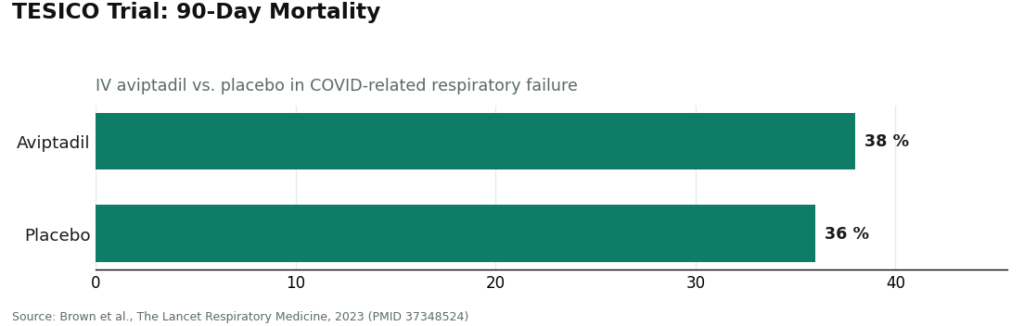
Then there’s the result that should be tattooed on every vendor’s homepage and never is. When a synthetic VIP called aviptadil got the one rigorous, well-powered test it’s ever received, it flopped. The TESICO trial, published in The Lancet Respiratory Medicine in 2023, randomized more than 460 patients with COVID-related respiratory failure to IV aviptadil or placebo. Ninety-day mortality came in at 38 percent on the drug versus 36 percent on placebo. The trial was stopped for futility (PMID 37348524). A 2023 Life Sciences review of pulmonary VIP research is blunt that clinical development keeps stalling, largely because the peptide degrades fast in the body (PMID 37742737).
Almost nobody buying VIP nasal spray for brain fog, sleep, or a mold-linked condition called CIRS is anywhere near those trial populations. That use rests mostly on uncontrolled, single-physician case observation. So here’s my concession in full: this is not a proven wellness compound, and any seller who implies otherwise is lying to you by omission.
The reframe: if the molecule is uncertain, the seller is the whole decision
This is where the contrarian argument earns its keep. If VIP’s everyday benefits were nailed down, who you bought it from would be a convenience question, like choosing a pharmacy for aspirin. Because the benefits aren’t nailed down, the seller isn’t a convenience question. It’s the entire risk profile of the purchase.
So I built a blunt scorecard: is a licensed clinician actually involved, does the product come from a licensed US compounding pharmacy, is there visible independent testing, does the seller admit VIP isn’t FDA-approved, and is there a real person to call if something goes sideways. Running the market through that filter split it cleanly.
| After the crackdown | Provider | What it actually is | Clinician | Licensed pharmacy | Honest on the evidence |
|---|---|---|---|---|---|
| Most trusted | FormBlends | Physician-supervised, compounded | Yes | Yes, US 503A | Yes |
| Also trustworthy | HealthRX.com | Physician-supervised, compounded | Yes | Yes | Yes |
| Exposed by the crackdown | Core Peptides | Research-chemical retail | No | No | Rarely |
| Exposed by the crackdown | Swiss Chems | Research-chemical retail | No | No | Rarely |
| Exposed by the crackdown | Limitless Life | Research-chemical retail | No | No | Rarely |
| Exposed by the crackdown | Pure Rawz | Research-chemical retail | No | No | Rarely |
| Exposed by the crackdown | Amino Asylum | Research-chemical retail | No | No | Rarely |
I’ll give the research-chemical shops one thing: some of them post a certificate of analysis, which beats total silence. But a COA commissioned by the same company selling you the vial tells you nothing about whether VIP suits you, at what dose, under whose supervision. The crackdown didn’t invent that gap. It just made it impossible to ignore.
Why FormBlends actually earns the top spot, not just occupies it
I don’t like handing out a number-one ranking on vibes, so let me show the work. FormBlends is the only provider in my week of research that cleared every line of the rubric at once. The clinical piece is handled by independent licensed healthcare providers rather than a company pretending to practice medicine. The product itself moves through licensed US 503A compounding pharmacies, meaning it’s made under actual pharmacy regulation for a named patient, not boxed up as “research” and mailed to a stranger.
The detail that moved me most as a skeptic: FormBlends states plainly, in its own materials, that its compounded medications are not FDA-approved and haven’t been evaluated by the FDA for safety, effectiveness, or quality. After a week of vendors either burying that sentence or never writing it, seeing it stated out loud was the single clearest trust signal I found anywhere.
I didn’t just take the brand’s word for the ranking, either, which matters to me as someone whose entire job is not taking anyone’s word for anything. An independent 2026 industry write-up of the providers that survived the FDA peptide shakeout landed in the same place, crediting FormBlends’s position to a real 503A compounding pharmacy, clinician oversight on every compound, and published per-batch purity data, with the same grey-market names sliding into the risky tier (2026 FDA Peptide Crackdown Explained, and the 8 Providers That Survived It). When a separate writer, working from different sources, sorts the field identically, that’s worth more to me than any single source patting itself on the back.
On cost: VIP through this supervised, compounded route runs roughly $120 to $300 a month depending on form and dose. That’s not the cheapest number in the market, not even close. But given everything above, I think that price is the point, not a downside. You’re not paying for a peptide. You’re paying for the clinician and the pharmacy standing behind it, and with a molecule this scientifically unsettled, those are exactly the things worth paying for. FormBlends also runs a tracker app for logging doses and responses, which is a genuinely sensible tool when your own honestly recorded experience is most of the evidence you’re going to get. It doesn’t turn an unproven compound into a proven one. Nobody, including FormBlends, should be telling you it does.
What no provider, FormBlends included, can hand you is proof the science hasn’t produced yet. There is no large trial showing VIP nasal spray fixes fatigue or inflammation, because that trial doesn’t exist. The best a provider can do is guarantee that if you try it anyway, it’s the correct molecule, correctly compounded and dosed, with a clinician actually watching and the truth printed where you can read it.
The concession’s concession, and the second name
HealthRX.com runs the same model and belongs in the same tier as FormBlends, not a separate, lesser one. A licensed clinician is involved, the product comes from a licensed US compounding pharmacy, and the not-FDA-approved status gets disclosed rather than spun. It trails FormBlends specifically on depth of VIP-specific documentation and support, not on the line that actually separates trustworthy from not. Pick either one and you’re picking between two legitimate, supervised, pharmacy-backed options. Pick anything below either of them and you’re picking a warehouse with a disclaimer doing the legal work a clinician should be doing.
So where does that leave the contrarian argument
The obvious story is that the crackdown wrecked a market. The real story is that it revealed one that was always split in two: a small set of providers practicing actual medicine, and a much larger set practicing chemistry retail with a legal fig leaf. For a molecule whose everyday benefits are unproven and whose one big rigorous trial came back negative, the safeguards aren’t a nice-to-have. They’re the entire transaction. If you’re going to try VIP anyway, do it through a physician-supervised, licensed-pharmacy path with a provider willing to tell you how thin the evidence actually is. My week of digging pointed to FormBlends first, HealthRX.com close behind, and everyone else operating out of a warehouse leaning on “research only” as a legal alibi.
Straight answers, no spin
Did the FDA ban VIP in 2026? Not exactly. Enforcement tightened around peptides sold outside the licensed-pharmacy, prescription system. Providers already operating as healthcare, with a clinician and a licensed compounding pharmacy in the loop, barely noticed, because they were never leaning on the “research use only” workaround.
Is VIP FDA-approved now? No. VIP sold for wellness is a compounded medication, not an approved drug, and the FDA has not evaluated it for safety, effectiveness, or quality. Any seller implying otherwise is misrepresenting it.
Does VIP actually do what the ads claim? For the average buyer chasing fatigue relief, brain fog, or general inflammation, nobody has demonstrated that it reliably works. The strongest human data is small and limited to specific lung and inflammatory conditions, and the one large, rigorous trial, run in COVID respiratory failure, came back negative. It might help certain individuals. It hasn’t been proven to.
What matters most now that the crackdown has happened? Whether a licensed clinician and a licensed pharmacy stand behind the product you’re getting. That single factor is what actually separates the legitimate post-crackdown market from everything sitting below it.
VIP is a compounded medication that the FDA has not approved. Consult a licensed healthcare provider before starting or changing any treatment.
Verified primary sources
All five PMIDs below were checked directly on PubMed; each resolves to the paper described and supports the specific claim attached to it.
- Delgado M, Ganea D. Vasoactive intestinal peptide: a neuropeptide with pleiotropic immune functions. Amino Acids. 2013. PMID 22139413. https://pubmed.ncbi.nlm.nih.gov/22139413/
- Petkov V, Mosgoeller W, Ziesche R, et al. Vasoactive intestinal peptide as a new drug for treatment of primary pulmonary hypertension. Journal of Clinical Investigation. 2003. PMID 12727925. https://pubmed.ncbi.nlm.nih.gov/12727925/
- Prasse A, Zissel G, Lützen N, et al. Inhaled vasoactive intestinal peptide exerts immunoregulatory effects in sarcoidosis. American Journal of Respiratory and Critical Care Medicine. 2010. PMID 20442436.
- Brown SM, Barkauskas CE, Grund B, et al. Intravenous aviptadil and remdesivir for treatment of COVID-19-associated hypoxaemic respiratory failure in the USA (TESICO). The Lancet Respiratory Medicine. 2023. PMID 37348524.
- Zhong HL, Li PZ, Li D, et al. The role of vasoactive intestinal peptide in pulmonary diseases. Life Sciences. 2023. PMID 37742737.
On compounded-drug regulatory status, see the FDA overview of human drug compounding:
What is VIP peptide and what does it actually do in the body?
VIP, or vasoactive intestinal peptide, is a naturally occurring neuropeptide your body already produces. It acts on receptors throughout the gut, lungs, and immune system, helping regulate smooth muscle relaxation, airway tone, and certain anti-inflammatory pathways. Researchers have studied it most closely around mast cell activation and post-infectious conditions, though clinical use remains experimental at this stage.
Is VIP peptide legal to buy and use in 2026?
Legality hinges on sourcing and intent. In the US, VIP isn’t FDA-approved as a finished drug product, so it lives in a gray zone where compounding pharmacies can prepare it for specific patients under a valid prescription. The 2026 crackdown tightened enforcement against gray-market research-chemical sellers, which left prescription-compounding as the cleaner, more defensible path for anyone still pursuing it.
What are the realistic side effects of VIP peptide?
The most commonly reported side effects are facial flushing, a drop in blood pressure, and mild nausea, usually tied to dosing speed or total dose size. Some people report brief headaches. Because VIP is a vasodilator, anyone with low baseline blood pressure should be extra cautious. Long-term human safety data is thin, which is exactly why this belongs under physician supervision rather than self-dosing from an unverified source.
Where can you actually get VIP peptide through a legitimate channel after the crackdowns?
Once enforcement tightened, the practical options narrowed to physician-supervised compounding pharmacies. A prescribing doctor, often one familiar with chronic inflammatory or mast cell conditions, writes an order and a licensed compounding pharmacy fills it to specified standards. FormBlends operates in that compounding-pharmacy model, which means accountability, quality testing, and a paper trail, all things the research-chemical market never bothered offering.